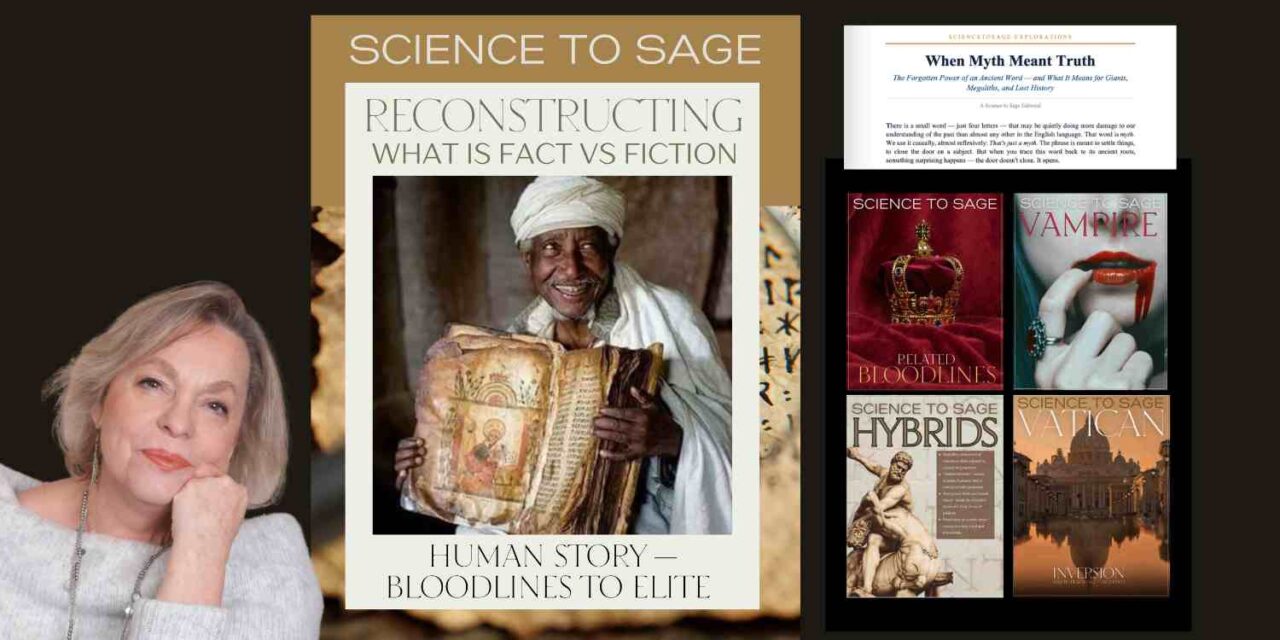
Human story — Bloodlines to Elite

See Blog Post for Series on Human History

Remembering Forward

To understand who we are becoming, we must remember who we have been—across cycles, across resets, across mythic memory.

The story of humanity did not begin 6,000 years ago. It is far older, far deeper, and far more cosmic. It is also full of shadow, as well as light.

Somewhere between the lines of recorded history and the margins of myth, there exists a territory most institutions dare not enter—where fact and fiction dissolve into something more dangerous and more honest: pattern. Where the stonecutters of lost civilizations echo in the precision of modern architecture. Where royal bloodlines thread through millennia like rivers underground, invisible until they surface in the faces of those who govern us still. Where flood narratives from a hundred cultures converge not as metaphor, but as memory.

This issue of Science to Sage ventures into that territory.

We live in an age of excavation—not merely of soil and rock, but of story, of record, of inherited assumption. The deeper we dig, the more we find that what was dismissed as legend carries the signature of lived experience. That what was called myth may be the only vessel large enough to hold truths too vast for a history textbook. That what was labeled conspiracy may be the faint outline of a continuity far older than any nation-state.

From the god-kings of antediluvian memory to the rock-cut architectures that defy conventional timelines… from the curated genealogies of ruling elites to the curious convergence of hybrid traditions across unconnected cultures… from the great floods encoded in stone and scripture to the quiet inversions embedded within the world’s most powerful institutions—we find not chaos, but coherence. Not randomness, but recursion.

Because that is what cycles do. They return. They reset. They invite us, if we are paying attention, to recognize where we are in the spiral.

This is not a comfortable issue. It was not designed to be. The questions raised here press against the edges of what we have been permitted to know, encouraged to believe, and trained to dismiss.

The bridge between fact and fiction is not made of compromise. It is made of courage—the courage to hold complexity, to sit with paradox, to ask: what if the story is far bigger than the story we were told?